Quantum Frontiers: Reflections from my visit to Quanfluence
⚛️ Quantum computing is no longer a distant theoretical promise. It is rapidly becoming a transformative technology with profound implications for science, industry, and society.
Recently, I had the opportunity to visit a top innovation startup - Quanfluence, established in 2021, is a pioneering photonic quantum computing company in Bangalore, India, and to witness firsthand how abstract concepts of quantum physics are being translated into tangible hardware. Mr Biman Chattopadhyay and his team at Quanfluence shared very insightful information and enthusiastically walked me through their laboratory. As a Physicist and Deep Tech professional, I found the experience particularly insightful: it offered a rare glimpse into how cutting-edge experiments in quantum optics are converging with scalable engineering, and how these developments resonate both with academic research and industrial needs.
⚖️ Quantum Principles in Action
At its core, quantum information science is built on principles that redefine what computation can achieve.
Unlike classical bits, which are confined to values of 0 or 1, qubits can exist in linear combinations of states using superposition (see Hughes et al., 2021), unlocking parallelism at the computational level.
\[|\psi\rangle = \alpha|0\rangle + \beta|1\rangle\]Equally transformative is entanglement (see Horodecki et al., 2007), where correlated states like
\[|\Phi^+\rangle = \frac{1}{\sqrt{2}}\left(|00\rangle + |11\rangle \right)\]create non-classical connections across space, forming the backbone of quantum communication and distributed computation.
Beyond these foundations, advanced states such as cat states and cluster states underpin measurement-based models and fault tolerance. Quantum key distribution (QKD) (see Sacarani et al., 2009) demonstrates how single-photon exchanges can create unbreakable communication channels, while quantum–classical interfaces explore ways of embedding real-world data into quantum states for acceleration.
Of course, the elegance of these principles comes with significant challenges. Noise, decoherence, and the need for error correction remain central concerns, with strategies like surface codes and thermal stabilisation paving the way toward scalable machines. At the same time, boson sampling provides a near-term benchmark of photonic advantage, highlighting how light itself becomes a natural substrate for quantum computation.
These principles, which I once approached in purely theoretical contexts, were now presented as active research avenues with tangible engineering pathways.
🔧 From Abstract Physics to Quantum Hardware
At Quanfluence, two complementary approaches illustrate this transition from principle to practice:
Optical Breadboard Setups
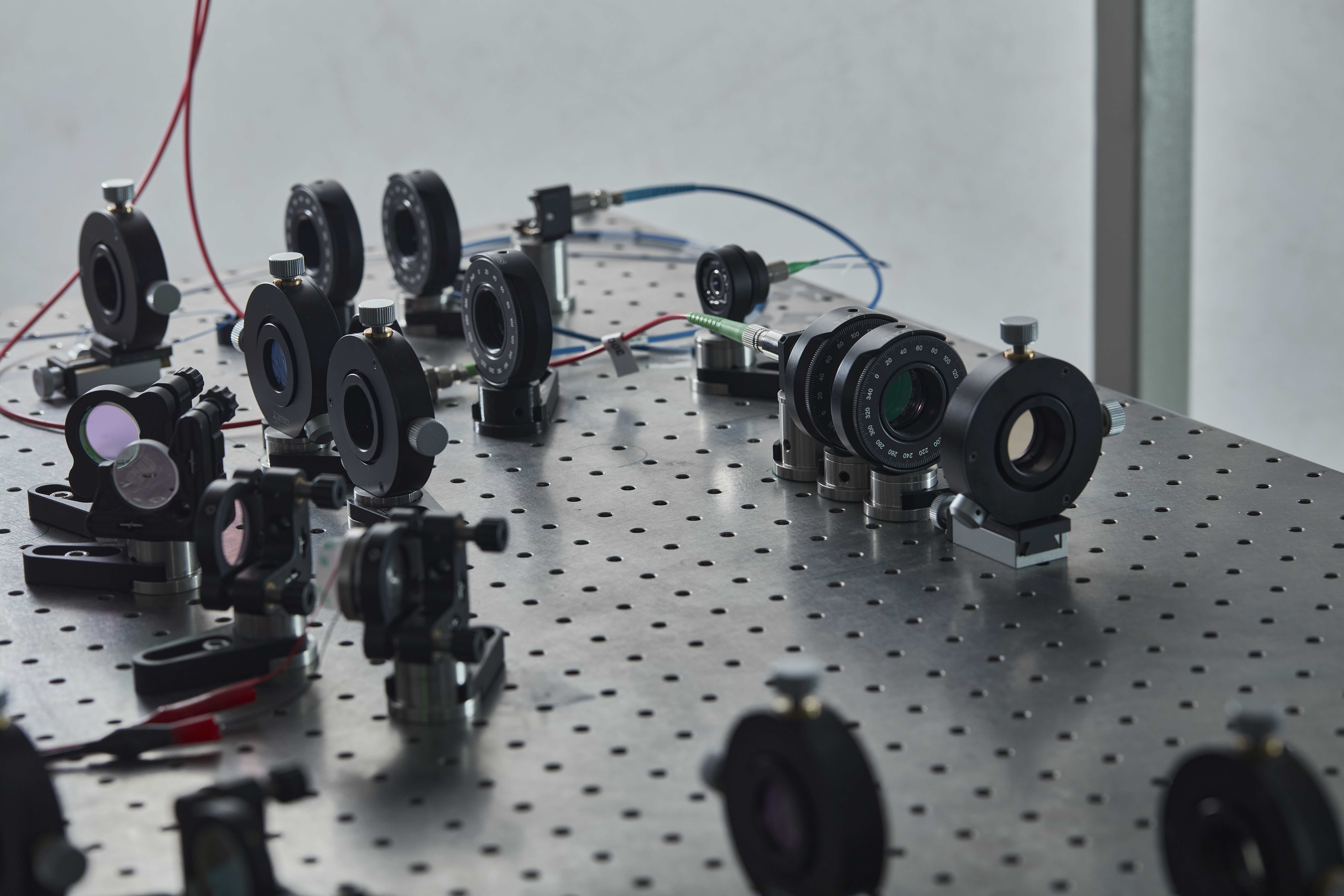
Optical Breadboard Setup at Quanfluence Lab
Here, mirrors, lenses, and nonlinear crystals are aligned to create effectively infinite light paths. Photons undergo multiple reflections, extending their interaction lengths; ideal for generating entanglement, reducing noise in the quantum spectrum, and testing fundamental quantum optical phenomena.
While the optical breadboard is a fantastic proof-of-concept, they explained that it is limited to a physics experiment. To build a scalable computer, the content of an 8ft x 6ft breadboard has to be compressed into a chip. That is how even the electronics industry has scaled over decades, starting from vacuum tubes to integrated circuits. And that’s precisely what I got to see in the next section of the lab.
Photonic Ising Machines
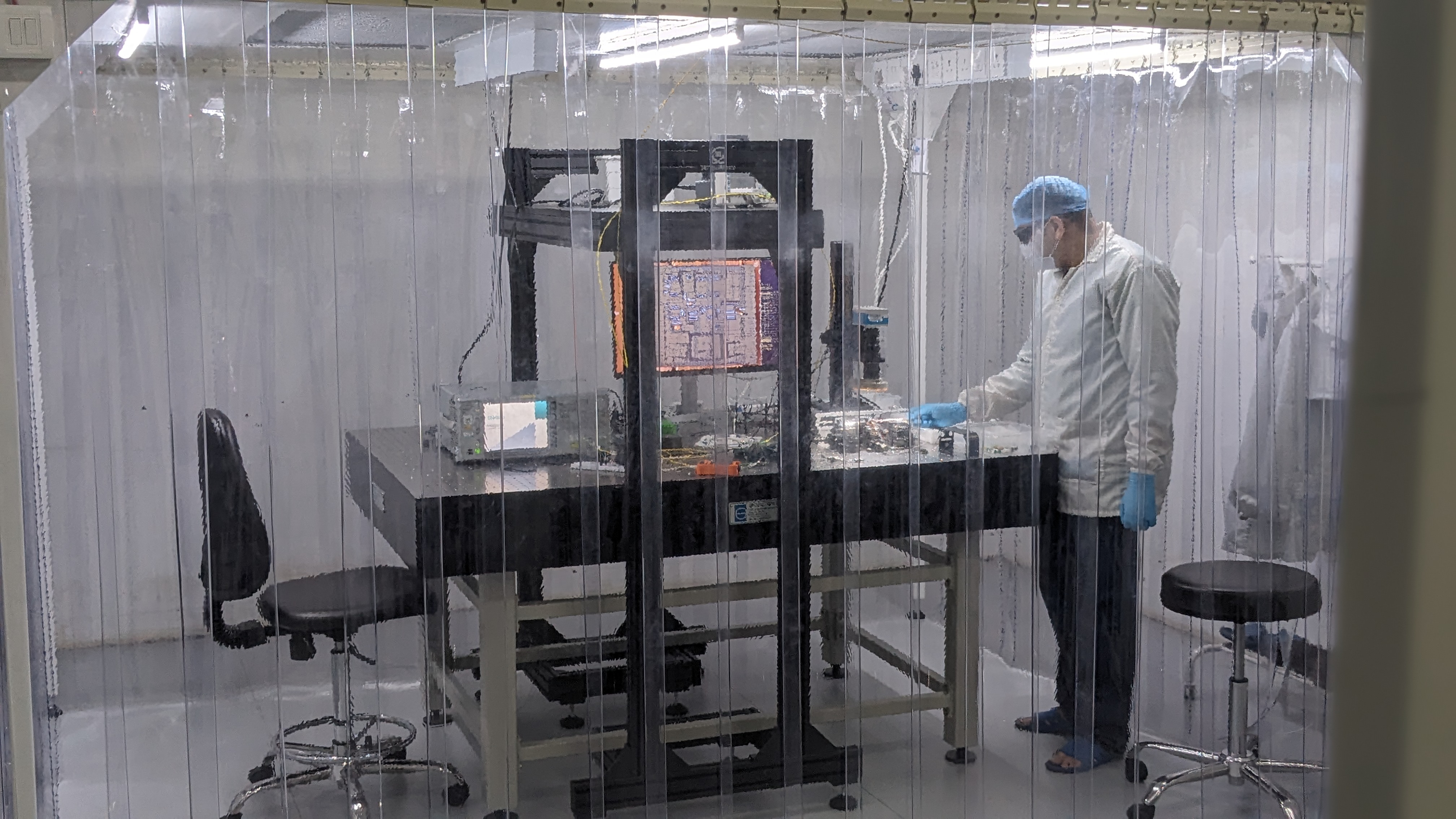
This part of the lab is where I could see how the full table top set-up gets squeezed down into a small ~100 micron circuit on a 0.5mm x 0.5mm photonic integrated chip.
Micro Chip Lab
The principle of the Ising Machine is driven by spin systems. A physical system containing an ensemble of interacting spins tends to settle to the lowest energy state. This maps to an optimisation problem where each decision variable is a spin and their interaction defines the problem statement.
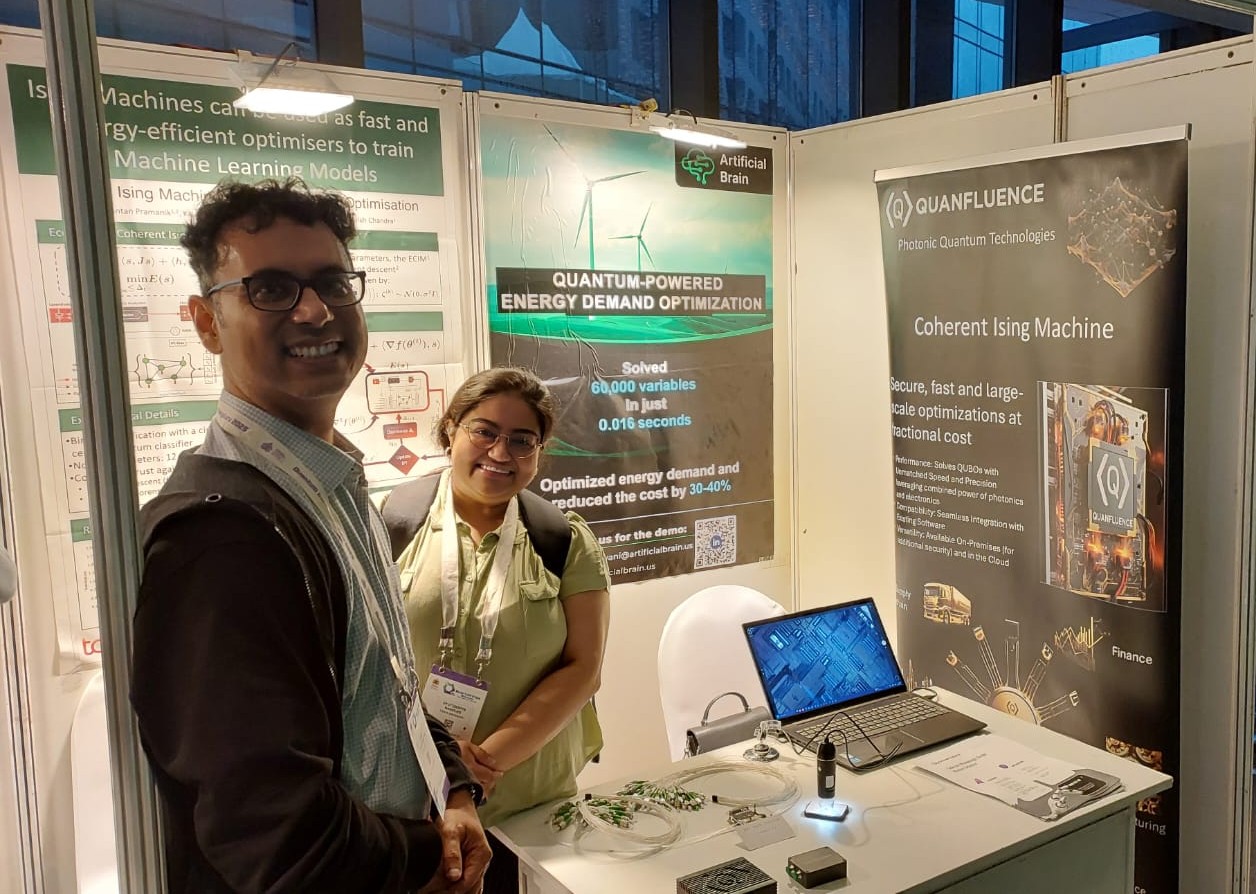
A photonic Ising machine is a quantum-inspired hardware that solves the Ising problem by starting from a random high-energy state and settling towards the lowest energy state. The Quanfluence photonic Ising machine does exactly that. I had seen the Quanfluence Ising machine at the Quantum India Bangalore Summit 2025.
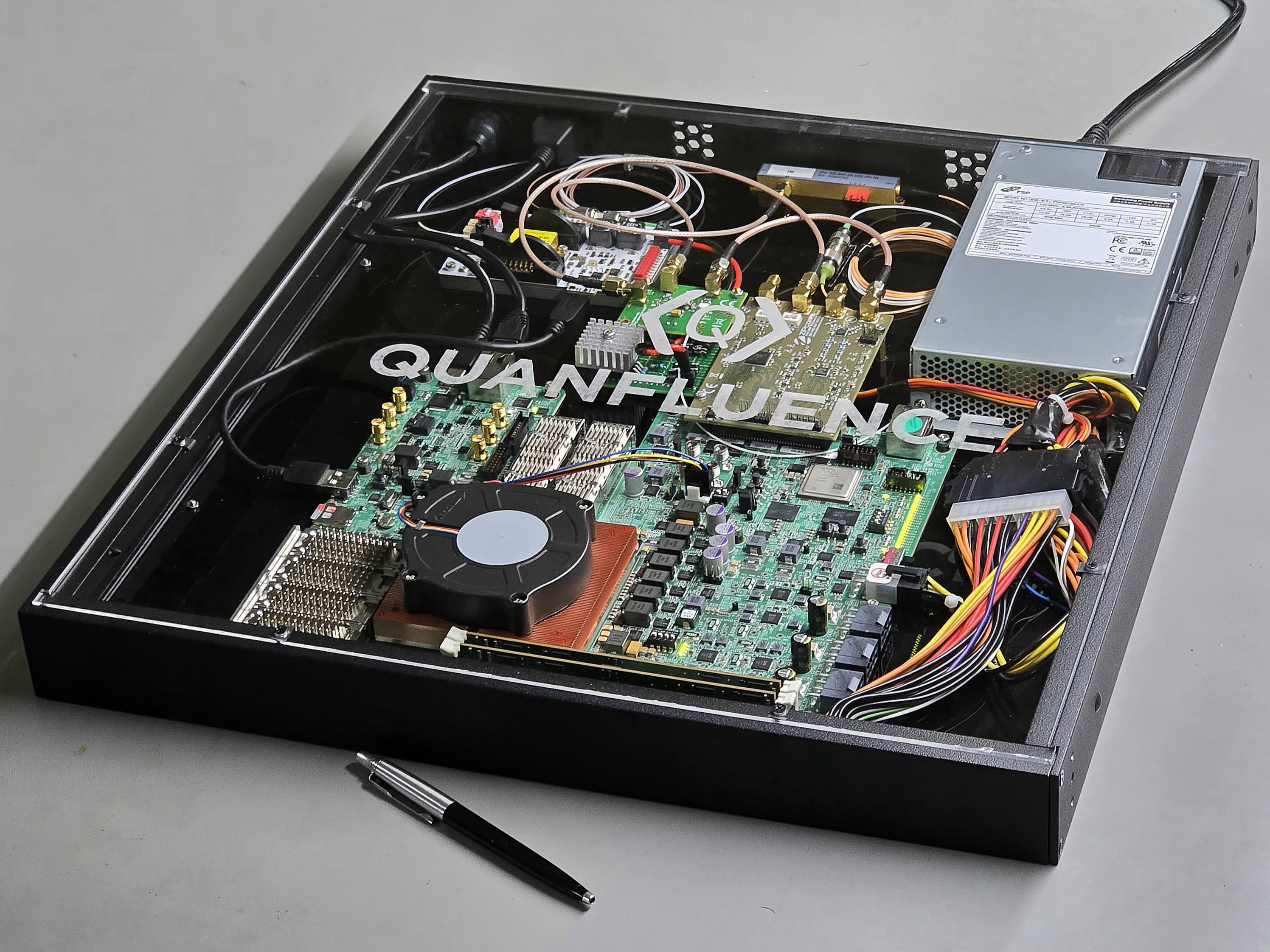
Quanfluence Micro Chip
In the lab, I got to see their development flow. There is an FPGA system which is hooked up to an optical system with custom circuits built at Quanfluence lab. I could clearly trace the path of the gain dissipative loop inside the hardware box. They showed us the earlier variants of the machine and how it has evolved from a lab prototype to a full-fledged rack-mountable machine.
Together, these setups represent both scalability and flexibility: the chip-based systems lean toward industrial readiness, while the breadboards enable exploratory research.
❓ Why Quantum Computing Matters
Quantum computing matters because it addresses problems that classical machines cannot solve efficiently. By leveraging superposition and entanglement, quantum systems explore enormous solution spaces in parallel, offering an advantage where complexity explodes exponentially.
- Healthcare & Drug Discovery: Quantum simulations allow molecular interactions to be studied in unprecedented detail, opening the door to personalised treatments and novel drug development.
- Finance: Portfolio optimisation, risk analysis, and fraud detection may benefit from more efficient quantum-enhanced algorithms.
- Artificial Intelligence: Variational quantum algorithms and hybrid quantum-classical models promise to speed up machine learning and enable models that capture richer, more complex structures.
- Materials & Energy: Designing superconductors, optimising batteries, and improving renewable energy systems all rely on computations that quantum systems can accelerate.
- Cybersecurity: While quantum algorithms threaten current encryption standards, quantum key distribution and post-quantum cryptography provide new frameworks for secure communication.
- Optimisation: From supply chain logistics to financial portfolio management, quantum-inspired algorithms can accelerate decision-making in environments with countless possibilities.
For academia, these opportunities create fertile ground for new algorithms, models, and theoretical advances. For industry, they represent emerging markets and competitive advantages in sectors from finance to pharmaceuticals.
🧩 Bridging Physics and Industry
As a Physicist, what struck me most during my visit to Quanfluence was the fusion of theory and engineering. How the principles of quantum physics, once confined to abstract mathematics, are now being reframed as solutions to global challenges.
Superposition and entanglement, once purely abstract, were manifest in real devices - whether in a chip embedded with interferometers maintaining squeezed-light states or in a breadboard setup generating entangled photons. Quanfluence exemplifies the delicate balance between rigorous scientific inquiry and real-world application.
As someone trained in Physics and engaged in AI and Data Science, I found this duality inspiring. On one hand, the intellectual elegance of quantum principles remains intact; on the other, the practical urgency of deploying them is shaping the research agenda.
The road ahead is not without obstacles. Fragile states must be stabilised, error correction remains daunting, and scalability is still under construction. Yet, the pace of progress is undeniable.
Companies like Quanfluence demonstrate how fundamental research and applied engineering can come together to position India within the global quantum ecosystem.
For researchers, it’s a call to innovate. For industries, it’s a chance to adopt early and lead. And for professionals like me who straddle the line between theory and application, it’s a reminder that the future of deep tech lies in building bridges between physics and engineering, research and product, academia and the market.
🧠 Closing Thoughts
Visiting Quanfluence underscored for me that we are standing at the edge of a technological shift. Quantum computing is not merely an academic curiosity - it is rapidly becoming a driver of economic, medical, and societal transformation.
For me, as someone who began with equations on a blackboard, witnessing photons inside chips reminded me that the future of deep tech belongs to those who dare to bridge theory and practice. As the nobel laureate Dr. David Gross rightly said at QIB 2025, and the fact that I witnessed all this happen in my home country, India, made it even more inspiring!
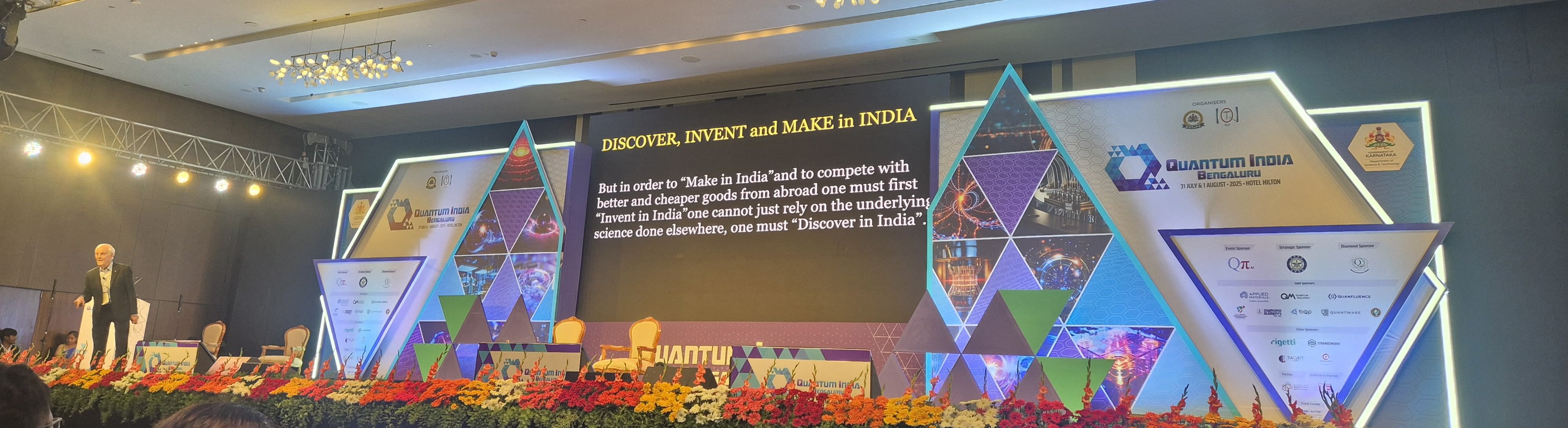
Quantum computing will not only redefine the limits of computation but also the way we approach complex problems across disciplines.
Observing these efforts up close reaffirmed for me that the quantum revolution is no longer theoretical. It is unfolding, photon by photon, qubit by qubit, breakthrough by breakthrough.
✍️ Have thoughts on this? I’d love to hear your perspective on the upcoming Quantum leap. Drop me a message or connect on LinkedIn.