Why Physics Matters in AI
💡 How can a Physicist’s mindset shape the future of Artificial Intelligence? Let’s dive into why Physics matters, even more in the age of Data.
🧠 The Physics Mindset: More Than Just Equations
Physics teaches you how to think, not just how to compute. At its core, Physics is about:
- Understanding systems
- Modelling complexity with simplicity
- Looking for invariants (what stays the same when everything else changes)
These qualities are extremely valuable in AI, especially when:
- You’re working with noisy real-world data
- You want to build interpretable and generalisable models
- You need to go beyond “black-box” pattern fitting
🔍 From Data to Structure: Why AI Needs Physics
While modern AI excels at finding patterns, it often lacks a solid foundation in the laws of the physical world.
Here’s where physics steps in:
| Problem in AI | Physics-Informed Advantage |
|---|---|
| Models overfit noise | Physics introduces structure and constraints |
| Lack of explainability | Physics provides causality and meaning |
| Poor generalization | Physics-based priors improve extrapolation |
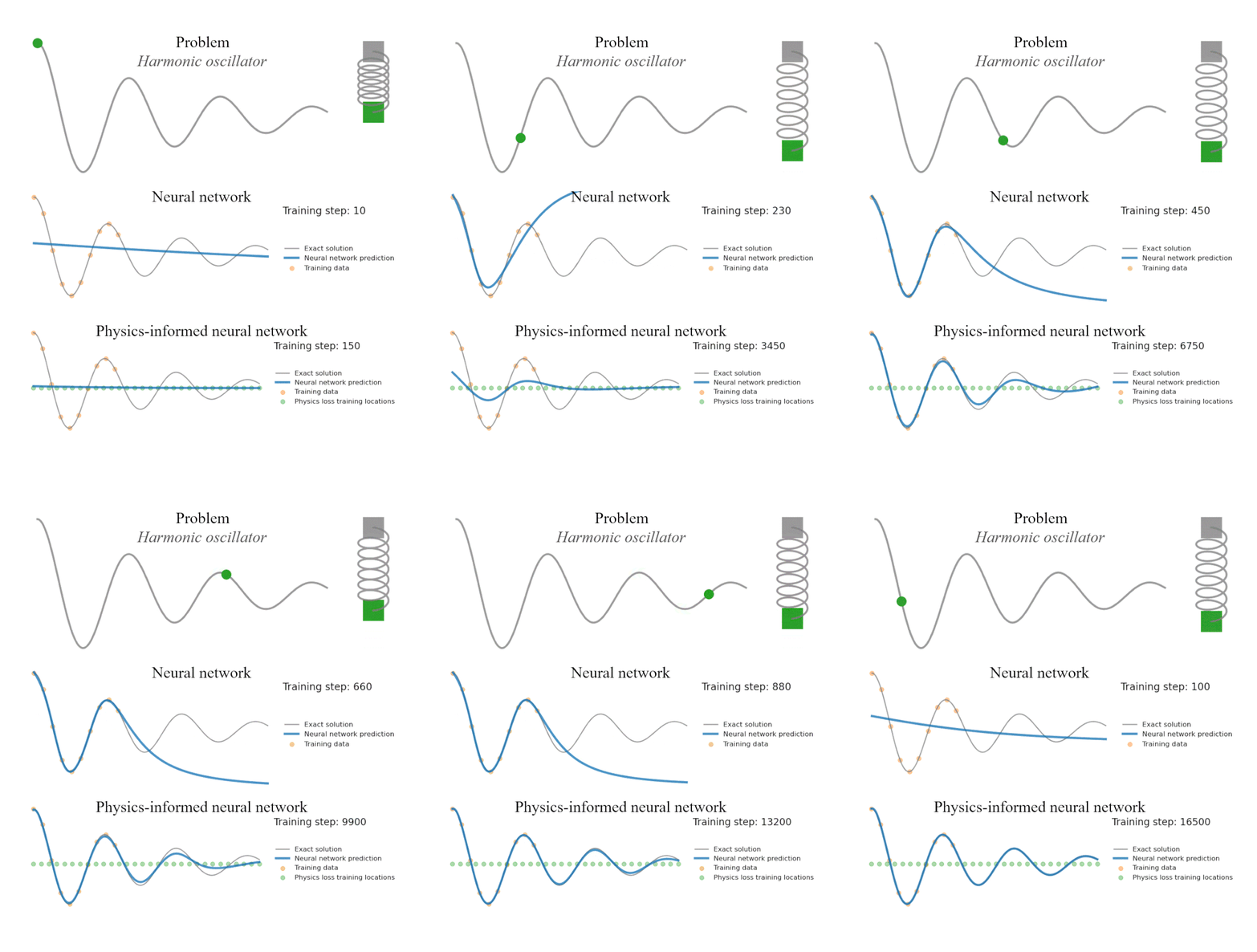
Animation of Physics-Informed Neural Network for Harmonic Oscillator problem.
Source: Reddit - r/learnmachinelearning
💼 My Experience: From Feature Detection to Motion Analysis
As someone trained in Physics and working in AI:
- I’ve built deep learning models to detect sinuous rilles (lunar lava tubes) from multispectral satellite imagery, combining morphological geosurface analysis with the power of pattern recognition.
- In my fluid mechanics experiments, I verified Reynolds number–dependent drag behaviour through motion tracking and trajectory analysis using Physics to validate and reinterpret real-world observations.
- I built and analysed bristlebots, tiny motorised robots whose behaviour emerges from vibrational dynamics-modelling their motion and control across collective systems, and grounding robotics in fundamental mechanical principles.
- Even in health-tech and industrial vision, I bring Physics intuition to define meaningful features, not just extract statistical patterns.
🧮 My takeaway: When you understand why things behave the way they do, AI becomes not just predictive, but explanatory.
🧩 Physics-Informed AI: The Future Is Hybrid
Emerging approaches like:
- Physics-Informed Neural Networks (PINNs) are a cutting-edge approach that blends neural networks with the governing equations of Physics (see Raissi et al., 2019). This hybridisation enables models to generalise better and remain physically plausible, even when data is scarce or noisy.
- Hybrid models (AI + differential equations) (see Schweidtmann et al., 2024) combine machine learning with Physics-based equations (like fluid dynamics or motion laws) to create AI systems that respect real-world constraints, resulting in more interpretable and reliable predictions than pure data-driven models.
- Simulation-to-vision pipelines utilise Physics-based simulations (e.g., virtual environments that mimic gravity or lighting) to generate synthetic training data for computer vision systems, thereby improving their ability to analyse real-world images and videos while reducing dependency on scarce experimental data.
All reflect the same idea: AI grounded in Physical laws is more robust, interpretable, and transferable across domains.
🎯 Final Thoughts
In a world flooded with Data, Physics helps us ask better questions.
Whether we’re modelling space, health, or motion, AI needs anchors. Physics provides those anchors.
If you’re a Physicist venturing into AI, recognise the unique superpower you bring: the ability to uncover hidden symmetries in both reality and reasoning.
Let’s build not just deeper, but smarter systems.
✍️ Have thoughts on this? I’d love to hear how Physics influences your work in AI. Drop me a message or connect on LinkedIn.